Housebreaking Your Dog
What Housebreaking Really Is
Housebreaking can feel frustrating.
You take your dog outside, nothing happens. Then they come inside and go on the floor.
It starts to feel confusing or even intentional.
Housebreaking isn’t a behavior problem.
It’s a timing and management problem.
Your dog hasn’t yet learned:
- where to go
- when to go
- and how to hold it in between
Until those pieces are clear, accidents will keep happening.
Why Accidents Happen
Most accidents aren’t random.
They happen when your dog has:
- too much freedom
- not enough supervision
- or unclear timing
Dogs don’t generalize well early on.
Just because they’ve gone outside before doesn’t mean they understand that outside is the only place to go.
They also don’t yet know how to tell you they need to go.
So they go when the urge hits.
That’s not your dog being stubborn.
It’s a gap in understanding.
If accidents are happening, timing is usually the issue.
Most dogs aren’t taken out often enough, or at the right moments during the day. Without a clear rhythm, it’s hard for them to succeed.
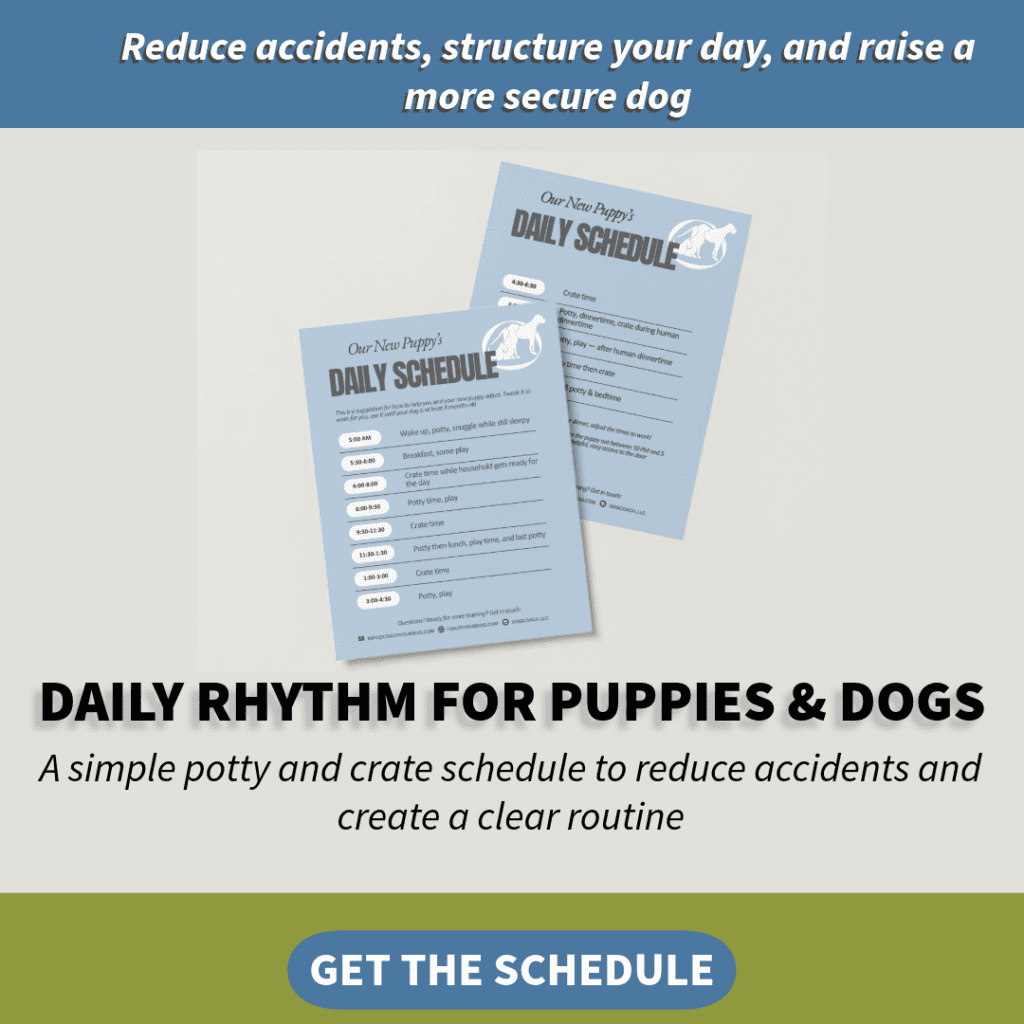
We put together a simple daily schedule to make this easier:
The Foundation: Structure and Supervision
Housebreaking improves quickly when your dog’s day becomes more structured.
Instead of guessing, you start controlling:
- when your dog goes out
- where they are in the house
- what they have access to
This is where most people make the biggest shift.
More freedom does not speed up housebreaking.
Clear structure does.
Where to Start
Start here:
- take your dog out on a consistent schedule, especially after waking, eating, or playing
- bring your dog to the same spot outside each time
- stay with them and wait until they go
- reward immediately when they finish
Then, inside the house:
- keep your dog supervised or confined
- use a leash in the house so you can guide them if needed
- interrupt and bring them outside if you see signs they’re about to go
Consistency matters more than anything here.
If you’re unsure how to space out crate time, potty breaks, and activity throughout the day, start with a clear structure you can follow.
→ Get the Schedule
Why Crate Training Helps
Crate training is one of the most effective tools for housebreaking.
When introduced properly, the crate becomes a place your dog can settle and hold it.
Dogs are naturally less likely to go to the bathroom in a space where they rest. It’s also easier to clean up.
That makes the crate useful for:
- preventing accidents
- building bladder control
- creating structure between outings
If your dog is not yet crate trained, this is an excellent place to start.
→ Read: How to Crate Train Your Dog
Using the Leash in the House
Many owners only use the leash outside.
But using a leash inside can make housebreaking much clearer.
It allows you to:
- keep your dog close
- interrupt accidents early
- guide your dog outside before they go
This shifts you from reacting after the fact to guiding in real time.
→ Read: Keeping a Leash on in the House
When It Starts to Click
As your dog begins to understand the pattern, things start to change.
They:
- go more quickly outside
- have fewer accidents inside
- begin to hold it for longer periods
This is not something your dog “figures out” on their own.
It happens because the pattern has been repeated clearly enough.
The Bottom Line
Housebreaking is not about correcting mistakes after they happen.
It’s about preventing them in the first place.
When you control timing, structure, and supervision, your dog learns what to do.
Without that, accidents are just part of the day.
With it, progress becomes predictable.